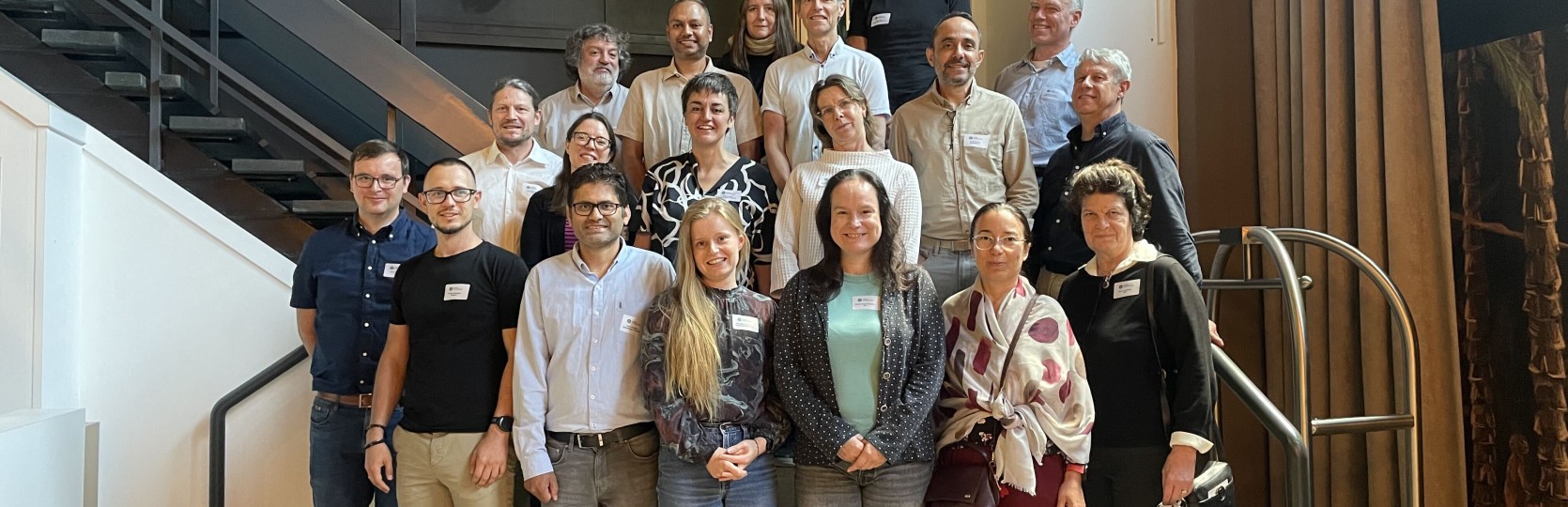
BALANSED kicks off in Wageningen to make environmental decisions more inclusive
We ask a lot from one piece of land. Food. Renewable energy. Carbon storage. Biodiversity. Local livelihoods.
The sea faces the same pressure. Protecting fragile ecosystems has to work alongside the needs of fishing communities and coastal economies. And as Europe speeds up its green transition, these choices get harder.
So how do we make environmental decisions work for both people and the planet?
Our answer is public deliberation. Scientists, policymakers, communities, businesses and industries look at the evidence together. Then they work towards decisions fair to every group involved.
This is the idea behind BALANSED (Biomass Assessment of Land and Sea for Engagement and Deliberation), a new Horizon Europe project. We launched on 9 and 10 June with a two-day kick-off meeting in Wageningen, the Netherlands.
Two days, 13 partners, 8 countries
Representatives from our 13 partner organisations in 8 European countries met in person. They introduced their expertise and mapped out the work ahead.
Partners also presented the project's work packages. They discussed how each contribution fits our shared vision: making environmental decision-making more transparent, participatory and evidence-based.
Why science needs your voice
Whether you are a scientist, a policymaker, a business owner or a local resident, decisions about land and sea use affect you. Finding the right balance takes two things: the science behind these challenges, and the views of the people who live with them every day.
BALANSED brings both into the same conversation.
Through six case studies across Europe, we will explore real-life environmental challenges. We will use the findings to build an Online European Public Deliberation Platform and a Deliberation Toolkit.
On the platform, citizens, researchers and policymakers will explore scientific evidence together, discuss different approaches and contribute to more balanced policy decisions. We won't tell you what the answers are. We will create the conditions for informed dialogue and shared understanding.
What happens next
The consortium is now underway. In the coming months, partners start work on the case studies, methodologies and digital tools. This work leads to a platform helping communities across Europe take an active role in shaping environmental policy.
One thing was clear in Wageningen. Good science alone won't solve Europe's environmental challenges. People need to be part of the conversation.
And this includes you.
Stay tuned to our website for more news on this exciting new chapter in environmental decision-making that benefits people and nature. You can also follow us on LinkedIn and Bluesky.
Project partners:
1. Wageningen University & Research
2. International Institute for Applied Systems Analysis (IIASA)
3. GFZ Helmholtz Centre for Geosciences
4. National Institute of Oceanography and Applied Geophysics (OGS)
5. Society for Territorial and Environmental Prosperity (STEP)
7. Slovenia Forest Service (Zavod za gozdove Slovenije)
8. Slovenian Forestry Institute (Gozdarski inštitut Slovenije)
9. Centre for Ecological Engineering (Ökoloogiliste Tehnoloogiate Keskus)
10. Cooperativas Agro-alimentarias de España
11. Cooperativas Agro-alimentarias de Castilla-La Mancha
12. URCACYL